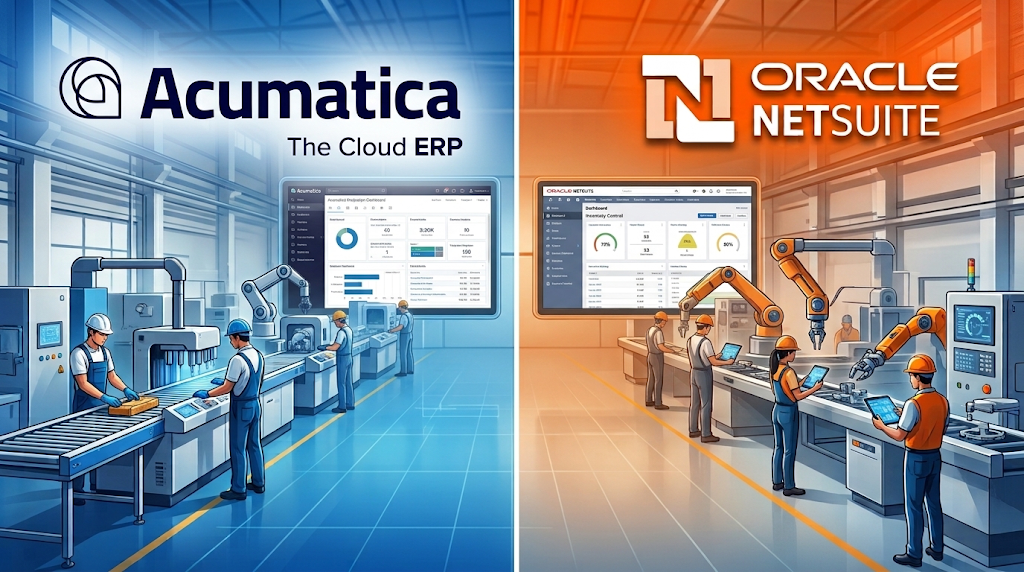
Canadian manufacturers comparing Acumatica and NetSuite need a structured way to pick the right Cloud ERP for manufacturing. Start by mapping real workflows, quoting, production scheduling, inventory, and month-end costing, then test how each system handles those steps, rather than just comparing long feature checklists.
Leaders in Canadian manufacturing often feel stuck between aging on-prem systems and cloud platforms that look similar on paper. Yet Acumatica and NetSuite take different approaches to pricing, deployment, and industry depth. Independent reviews, such as the 2026 comparison from ERP Research, highlight Acumatica’s strength in manufacturing-centric industries and NetSuite’s depth for complex corporate structures.
For a decision-stage comparison, focus on three outcomes: lower and more predictable operating costs, better real-time inventory visibility, and the ability to scale without rebuilding your ERP in five years. Each of the following sections translates those outcomes into practical Acumatica vs NetSuite differences for Canadian manufacturing SMEs.
Not every Canadian manufacturer sizing up a cloud ERP is actually ready for one. Plenty of shops with 20 to 60 people still run QuickBooks or Xero, and the real problem is that inventory counts drift, work orders live in spreadsheets, and production and finance no longer see the same numbers. Fishbowl is built for that step: an inventory and manufacturing platform for small and midsize businesses on QuickBooks or Xero, closing the operations gap before a full ERP project is warranted.
On the floor, Fishbowl handles bills of materials (BOMs), manufacturing orders (MOs), and work orders (WOs), with lot and serial tracking across multiple warehouses. SolidWorks BOMs can import directly, and per-user pricing includes unlimited locations, orders, and 3PLs, so extending access to supervisors or a second site is not a licensing negotiation.
Fishbowl then syncs that activity into QuickBooks or Xero as the system of record, which keeps cost of goods sold (COGS) and landed-cost allocation on cross-border shipments reconciled to the accounting ledger. For a Canadian SME that has outgrown spreadsheets but not the accounting system, that is often the intermediate step, not a full ERP replacement.
Cost control: pricing, licensing and total ownership
Both platforms can improve costing accuracy, but they manage commercial models very differently. Acumatica uses consumption-based pricing with unlimited users, while NetSuite typically licenses per named user plus modules. According to ERP Research, Acumatica’s model can cut user-related costs by 30–60% for teams with many warehouse or shop-floor users.
For a 60-person manufacturer with 25 people needing frequent system access, per-user licensing can become a major fixed cost. In that scenario, Acumatica’s unlimited-user model often allows you to extend access to more planners, supervisors, and temporary staff without renegotiating contracts. NetSuite may still be attractive if you have fewer users but heavy needs across finance and global consolidation.
Total cost of ownership also includes implementation, upgrades, and integrations. Vendors and partners commonly quote similar upfront project ranges, but ongoing costs diverge when you add new entities or capabilities. NetSuite’s renewals are often described as more rigid, with price uplifts at contract anniversaries, whereas Acumatica’s consumption focus gives manufacturers more control over scaling infrastructure rather than seats.
Inventory and production visibility on the shop floor
Inventory visibility and production control are where many Canadian manufacturers first feel the pain of disconnected systems. Both Acumatica and NetSuite support BOMs, routings, and MRP, but they differ in how easily shop-floor users can see and act on real-time data. The right choice depends on how your teams actually work.
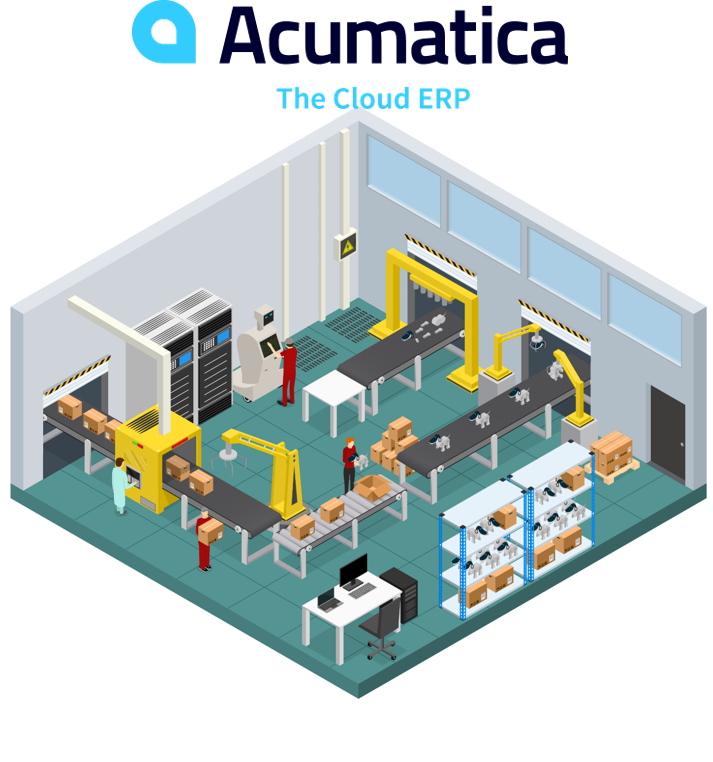
Acumatica is widely praised for its flexible dashboards and mobile access in manufacturing environments. For example, Western Canadian manufacturers profiled by Aqurus use Acumatica to track lot and serial numbers, work orders, and inventory across multiple warehouses in one real-time view. Forklift operators and line supervisors can update material movements with tablets instead of paper.
NetSuite also delivers real-time inventory and work-in-process data, with strong audit trails and links into finance and order management. It can be a good fit if your primary need is tight integration with financials and ecommerce. In practice, manufacturers should script scenarios like a late supplier delivery or an urgent rush order, then watch how easily each system updates MRP, reschedules jobs, and communicates changes to the floor.
Scalability and growth: multi-site, users, and complexity
When you think about scalability, look beyond database size. Consider how each ERP handles more plants, new product lines, and added users. Both Acumatica and NetSuite are proven for mid-market growth, but their sweet spots differ, especially for manufacturers planning expansion across Canada and into the U.S.
The 2026 ERP Research comparison notes that Acumatica is especially strong for make-to-order manufacturing, distribution, and field service. Its platform allows deployment in the cloud or, for specific cases, private hosting. That can appeal to manufacturers with strict data residency or integration requirements tied to existing plant systems.
NetSuite tends to win in scenarios with complex multi-subsidiary structures and heavy international operations. If your roadmap includes multiple legal entities, many currencies, and consolidated reporting across several regions, NetSuite’s global capabilities and large partner ecosystem can be hard to match.
For a Canadian SME with one to three plants and a growing product catalog, Acumatica often scales more than enough while keeping licensing and infrastructure straightforward. As you add lines or automation, it’s important to validate how both systems handle more transactions, IoT data, and advanced planning without slowing users down.
Localization: Canadian tax, currency, and compliance needs
Canadian manufacturers face distinct requirements: GST/HST, provincial sales tax in some provinces, bilingual documentation in certain regions, and cross-border trade with the U.S. and beyond. Any serious Cloud ERP for manufacturing evaluation must verify how each system supports these realities out of the box or via configuration.
Acumatica has strong support for multi-currency and Canadian tax rules through partners who specialize in this market. Implementers routinely configure GST/HST, PST where needed, and landed-cost tracking for imports. Some Canadian manufacturers also use Acumatica to manage excise or environmental fees through custom fields and reporting, keeping everything in one audit trail.
NetSuite offers robust tax and compliance tooling, especially for companies operating across multiple countries. Its strength lies in standardizing processes across entities while still handling region-specific needs. For example, a Canadian subsidiary may run GST/HST rules while a U.S. entity handles state sales tax, all within one global system.
In practice, you should ask each vendor to show a full Canadian sales order lifecycle, from quoting in both CAD and USD, to invoicing with the right taxes, to month-end reporting. Include a cross-border shipment and a return, so you can see how taxes, freight, and duties are handled in each platform.
How to run an effective Acumatica vs NetSuite evaluation
A good ERP comparison for manufacturing is more than a slide deck. Build a short, concrete script of your most common and painful workflows, then insist that both vendors run live demos using your data or realistic proxies. Keep the focus on cost control, inventory visibility, and scalability.
Industry advisors such as Intelligent Technologies recommend testing scenarios like engineering changes, WIP reporting, and schedule disruptions. For example, insert a last-minute design change and see how each system updates BOMs, routings, and cost rollups. Then ask how those changes flow into forecasts and profitability reports.
After the demos, score each system against a simple matrix: pricing predictability, user access flexibility, real-time visibility for operations, and fit for your three- to five-year growth plan. For many Canadian manufacturing SMEs, Acumatica scores higher on user access and manufacturing workflows, while NetSuite may lead on global finance and corporate structure. The best choice is the one that most clearly improves today’s operations while supporting tomorrow’s strategy.