Does your distribution business need ERP software help in 2026?
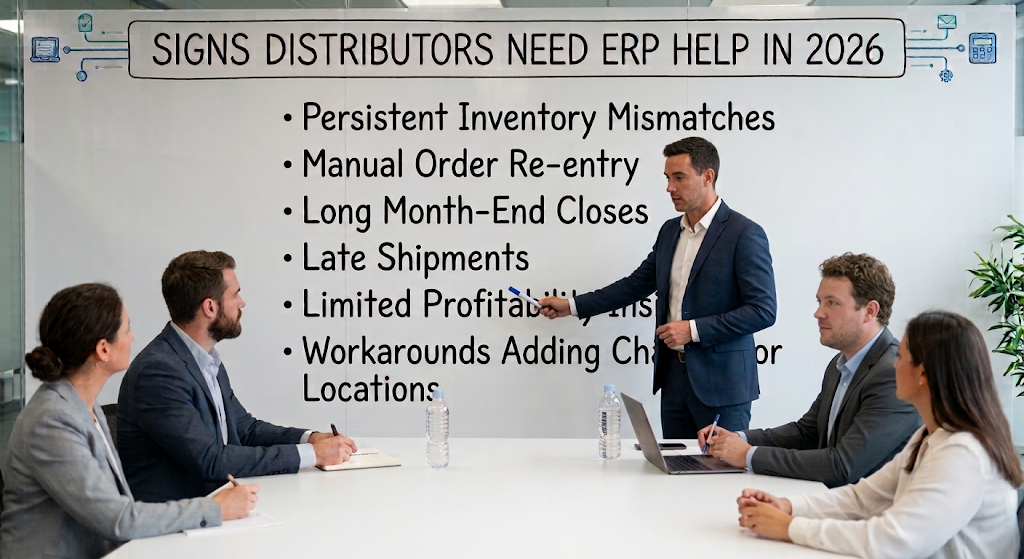
The signs distributors need ERP help in 2026 include persistent inventory mismatches, manual order re-entry, long month-end closes, late shipments, limited profitability insight, and workarounds when adding channels or locations. When two or more appear together, it is time to evaluate modern cloud ERP with a specialist partner like Aqurus.
For many mid-size distributors, the core pain point is that growth has outpaced entry-level systems. Accounting software and spreadsheets worked when you had a single warehouse and a handful of reps. Today you may run multiple locations, marketplaces, and eCommerce channels, yet your teams still reconcile data manually. That creates constant firefighting instead of scalable processes.
Industry research backs this up. A 2026 technology report from Distribution Strategy Group found that while 55% of distributors have invested in ERP, CRM, eCommerce, and analytics, most have not integrated them. High-maturity distributors run about 28 connected tools, while low-maturity peers average only five, leaving a sizable operational gap.
If this sounds familiar, you are not alone. Aqurus’ own article, 8 Signs Distributors Need ERP Help in 2026, outlines concrete warning signals, from frequent stockouts to outdated reports, that show when distributors have outgrown their current software.
Operational red flags: inventory, orders, and customer promises
Operational clues usually appear first. Inventory counts that do not match the system, orders that require re-keying, and shipping delays all signal that your processes are too manual. When warehouse, sales, and purchasing teams work from different versions of the truth, customers feel the impact through missed promises.
Research from ECOSIRE shows what happens when distributors modernize. In one study, improving order accuracy from 96.5% to 99.2% cut return-processing costs by 75%. Fill rates rising from 91% to 96% increased sales capture by 5% without adding new customers. These are the kinds of gains you miss when operations stay fragmented.
In practical terms, watch for patterns: cycle counts that always require adjustments, emergency purchase orders to cover preventable stockouts, or too many “where is my order?” calls. A distribution-focused ERP such as Acumatica can track lot numbers, bin locations, and reorder points in real time, so every team sees the same inventory picture.
Aqurus specializes in this operational foundation. Their ERP software overview highlights inventory management, sales order management, and warehouse workflows designed specifically for distributors that are ready to move past spreadsheet juggling.
Financial warning signs: reporting delays and margin erosion
Even when the warehouse is coping, finance often reveals deeper ERP issues. Month-end closes that drag beyond a week, manual journal corrections, and late profitability reports make it hard for leaders to respond to changing margins and cash flow in time.
ECOSIRE’s analysis of wholesale ERP ROI found that distributors using modern ERP reduced inventory carrying costs by 12–18%. They also shortened days sales outstanding by 10–18 days, unlocking $500K–$2M in working capital for a $20M distributor. Without this visibility and automation, many finance teams “fly blind” on margin until it is too late.
Common warning signs include limited ability to see profit by customer or product line, constant spreadsheet exports to calculate rebates, and difficulty reconciling intercompany transactions. When every new reporting request requires manual work outside your core system, you have effectively outgrown that system.
Aqurus often starts engagements with an ERP requirements assessment that maps these financial bottlenecks. By pairing Acumatica’s financial management and reporting dashboards with distributor-specific workflows, they help finance leaders move from rear-view reporting to real-time margin insight.
Technology gaps: spreadsheets, disconnected tools, and new channels
Technology architecture is another clear indicator. Many distributors bolt tools onto a basic accounting system, an eCommerce storefront here, a standalone WMS there, a separate CRM for sales. Each tool solves a narrow problem but adds complexity and re-keyed data.
Distribution Strategy Group’s 2026 report notes that high-maturity distributors integrate an average of 28 technologies, while low-maturity peers run only about five. The difference is not buying more tools; it is connecting the ones you already own. When new channels like marketplaces or B2B portals require manual imports, your architecture is holding you back.
Adding a Shopify or marketplace channel should not mean more spreadsheets. With Acumatica’s connected commerce and distribution capabilities, orders flow directly into picking, packing, and invoicing workflows. Aqurus explains this approach in their article on integrating eCommerce, distribution, and ERP manufacturing for growth, which shows how unified architecture eliminates data silos.
If IT spends more time troubleshooting sync jobs than delivering new capabilities, or if basic changes require custom scripts, those are strong signs you need a modern, cloud-native ERP platform tailored to distribution.
Why distributors work with Aqurus and Acumatica Cloud ERP
Knowing you have a problem is one thing; choosing a realistic path forward is another. Panorama Consulting’s 2026 ERP report found that more than a quarter of organizations exceeded their ERP project budgets, often because they discovered critical system misfits late and had to add extra technology or custom code.
This is where the right partner matters. Aqurus is an Acumatica gold-certified partner that has been implementing ERP for distributors and manufacturers since 2010. Their focus is on matching Acumatica Cloud ERP to real-world workflows in Western Canada, warehouse operations, supply chain, and multi-entity finance, not just selling licenses.
For distribution leaders, that translates into a structured, phased approach. Aqurus maps current processes, designs a future-state architecture, and uses Acumatica’s distribution and commerce editions to unify inventory, orders, and accounting. Their post on solving key supply chain challenges with Acumatica 2025 R2 shows how AI and automation now extend that value even further.
By working with a partner that understands distribution, you reduce project risk and move faster from warning signs to measurable operational improvements.
FAQs: Signs distributors need ERP help in 2026
How do I know my distribution business has outgrown its current software?
If you see frequent inventory mismatches, late shipments, and heavy spreadsheet use to connect systems, you have likely outgrown your current tools. Aqurus’ article 8 Signs Distributors Need ERP Help in 2026 provides a quick self-check for leaders.
What is an ERP requirements assessment, and why does it matter?
An ERP requirements assessment documents the features, integrations, and workflows your new system must support before you select software. This step reduces the risk of budget overruns, an issue for more than 25% of ERP projects, according to Panorama, and is a standard part of Aqurus’ selection services.
How long does an ERP implementation usually take for wholesale distributors?
Typical timelines for mid-size distributors range from three to nine months, depending on data complexity, integration scope, and the number of locations. Aqurus often phases projects, delivering quick wins, such as inventory accuracy or faster month-end close, before rolling out advanced analytics.
Can ERP help with eCommerce and multi-channel sales?
Yes. Acumatica Cloud ERP connects web stores, marketplaces, and traditional order channels so pricing, inventory, and orders stay synchronized. Aqurus uses Acumatica’s commerce edition to ensure distributors can add channels without adding manual work or giving up real-time visibility.
What makes Aqurus different from other ERP consultants?
Aqurus focuses on growing distributors and manufacturers, is an Acumatica gold-certified partner, and has delivered cloud ERP projects since 2010. Their team combines local knowledge of Western Canada with deep product expertise, helping you move from disconnected systems to a single, scalable ERP platform.