3 min read

Why Standard Multi-Carrier Shipping Tools Fail

Why Standard Multi-Carrier Shipping Tools Fail
Top Mistakes to Avoid: Integrated Multi-Carrier Shipping Software
7:10

Why Standard Multi-Carrier Tools Fail Complex Warehouse Workflows

For mid-market manufacturers and distributors, the warehouse floor is where profitability is won or lost. In an era of shrinking lead times, fluctuating fuel surcharges, and rising customer expectations, relying on basic or disconnected shipping software is a compounding liability.

Many logistics and operations leaders look for integrated multi-carrier shipping software only to find themselves forced into a frustrating compromise. On one end are entry-level, parcel-only e-commerce apps that completely choke when handed a multi-pallet Less-Than-Truckload (LTL) shipment. On the other are rigid, multi-million-dollar enterprise systems that require months of custom IT programming just to talk to your ERP.

To keep warehouse workflows moving at peak efficiency, distributors and manufacturers need an agile, deeply integrated middle ground. This guide compares the leading multi-carrier options for ERP-connected supply chains—and highlights why one industry veteran consistently fills the mid-market gap.

Mapping the Enterprise Shipping Landscape

When evaluating warehouse shipping automation, the software ecosystem generally falls into three main categories. Finding the right fit depends heavily on your volume, your carrier mix, and—most importantly—your ERP platform.

1. Dedicated System Giants (The Custom Middleware Layer)

Platforms like ShipERP and ProShip are built for the upper echelons of the enterprise market. ShipERP, for instance, lives natively inside SAP environments, making it a powerful choice for massive enterprises running SAP ECC or S/4HANA. ProShip focuses on pure, millisecond-level execution speed for ultra-high-volume multi-facility parcel operations.

  • The Catch: For the mid-market manufacturer or distributor running platforms like Sage 100, Acumatica, or Microsoft Dynamics, these tools represent a massive over-investment. They often require extensive middleware, long implementation timelines, and dedicated internal IT teams to maintain.

2. Infrastructure & Component Engines

Tools like ConnectShip (a UPS company) and ShipWise provide the foundational logistics architecture used by large software developers and specialized 3PLs. They are ideal if you are building a proprietary Warehouse Management System (WMS) from scratch and need raw carrier compliance APIs.

  • The Catch: They do not offer out-of-the-box, plug-and-play workflows. If you want seamless data synchronization with your ERP’s inventory, sales order, and invoicing modules right away, you will have to build those bridges yourself.

3. High-Volume E-Commerce & Cross-Border Parcel Apps

Platforms like ShipStation, Easyship, and Shippo are dominant in the direct-to-consumer (DTC) and retail e-commerce sectors. They excel at rapid batch-printing for lightweight parcel packages and connecting to online marketplaces.

  • The Catch: These are not Shipping Software for manufacturers. They lack the robust compliance logic required for industrial supply chains. Try processing an multi-item, NMFC-classified LTL freight shipment, managing return-to-vendor workflows, or automating custom Bill of Lading (BOL) documentation inside an e-commerce cart-connector, and your warehouse workflow will instantly grind to a halt.

The Mid-Market Standard: StarShip by V Technologies

For distributors and manufacturers running mid-market ERPs who need to seamlessly balance heavy LTL freight alongside high-speed parcel processing, StarShip by V Technologies has established itself as the industry standard.

Rather than trying to force an e-commerce tool upstream or an enterprise engine downstream, StarShip was engineered specifically to bridge the gap between complex warehouse logistics and mid-market financial systems.

Why StarShip Leads in Warehouse Shipping Automation:

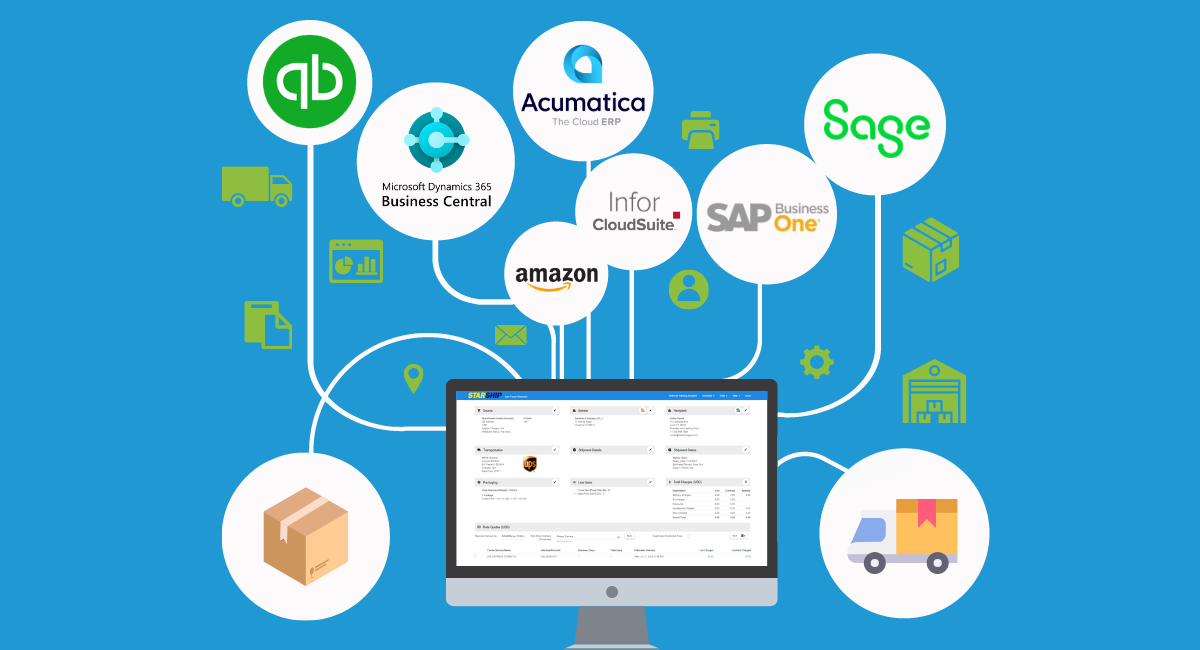
  • Deep, Native ERP Integration: StarShip doesn't just pass basic address data back and forth. It features deep, bi-directional integration into platforms like Sage 100, Acumatica, and Microsoft Dynamics. The moment a label or BOL is generated on the warehouse floor, StarShip instantly updates the ERP with tracking numbers, precise freight costs, and line-item shipment statuses—eliminating manual data entry and billing delays.
  • True Unified Parcel and LTL Freight: Warehouse teams don't have to switch between different applications or carrier portals. StarShip allows operators to rate-shop, manifest, and process both parcel (UPS, FedEx, USPS, regional carriers) and LTL freight carriers side-by-side in a single, consistent user interface.
  • Automated Logistics Compliance: For industrial shippers, paperwork errors mean costly chargebacks. StarShip automates the generation of complex, compliant documentation—including customized Bills of Lading, itemized packing lists, commercial invoices for international cross-border trade, and hazardous materials paperwork.
  • Dimensional Weight Optimization: StarShip pulls packaging dimensions directly into its rate engine, instantly calculating dimensional (DIM) weight. This prevents the costly "billback surprises" that occur when carriers adjust shipping rates after the fact.

At-A-Glance: Comparing Mid-Market Logistics Software

Feature / Capability StarShip by V Technologies E-Commerce Apps (ShipStation/Shippo) Enterprise Tools (ShipERP/ProShip)
Primary Target Market Mid-Market B2B Distributors & Manufacturers High-Volume DTC & Multi-Channel Retail Fortune 500 Enterprise & Global 3PLs
LTL / Freight Capabilities Advanced (Native rate shopping, BOL generation, NMFC tracking) Basic (Requires manual workarounds or external apps) Advanced (Highly customized, enterprise-scale freight routing)
ERP Connectivity Deep Bi-Directional (Sage, Acumatica, Dynamics out-of-the-box) Surface-Level (Relies on simple webhooks or cart-level sync) Native / Deep (Built specifically for tier-1 setups like SAP/Oracle)
Implementation Speed Fast (Pre-built ERP connectors mean rapid time-to-value) Instant (Plug-and-play, but lacks industrial depth) Slow (Requires extensive custom dev and scoping cycles)

The Verdict: Don't Starve Your ERP of Shipping Data

Your ERP is the single source of truth for your business operations, inventory control, and financial health. Leaving a disconnect between that core system and your physical warehouse floor is a recipe for operational bottlenecks, shipping errors, and lost margins.

If your warehouse is outgrowing basic parcel tools, or if you are looking to eliminate manual steps from your industrial fulfillment workflows, it’s time to look at a solution designed explicitly for your tier of business.

Discover how to fully automate your warehouse floor, cut freight spend, and maximize your ERP investment by exploring StarShip by V Technologies today.

If you enjoyed this article, you may be interested in the following similar articles:

The DIM Weight Wake-Up Call: 4 Ways to Reduce Shipping Costs

1 min read

The DIM Weight Wake-Up Call: 4 Ways to Reduce Shipping Costs

Shipping Costs Increased Since January 1, 2015 The DIM Weight Wake-Up Call: 4 Ways to Reduce Shipping Costs If you are an ecommerce, retail,...
Read More
Acumatica Integrated Credit Card Processing Saves You Time And Money

Acumatica Integrated Credit Card Processing Saves You Time And Money

Acumatica users now have an easier way to process credit cards that could save your company money. Using Acumatica credit card processing from...

Read More
What Does ERP Stand For? 9 Ways CRM Integration is Key to Adoption

1 min read

What Does ERP Stand For? 9 Ways CRM Integration is Key to Adoption

There are many references to the importance of ERP and CRM integration in our 8 previous blogs written about "What Does ERP Stand For?" Today we are...

Read More