5 Best ERP Shipping Add-Ons for Distributors in 2026
Distribution companies ship hundreds of orders a day. Every manual carrier lookup, re-keyed tracking number, or misrouted pallet chips away at your...
Choosing among Shippo competitors is not just a software comparison; it is a fulfillment strategy decision. Shippo can be a useful entry point, but growing ecommerce teams often need deeper ERP integration, more automation, broader parcel and LTL support, or a clearer path from checkout to warehouse. For ERPVAR.com readers advising merchants, the best recommendation is the one that reduces manual work, improves shipping visibility, and fits the customer’s operational maturity.
A strong Shippo alternative should match the way the business actually ships: sales channels, ERP or accounting system, warehouse process, carrier mix, return workflow, and reporting needs. If the company ships a few domestic parcels a week, simplicity may matter most. If it ships from an ERP-connected warehouse, across marketplaces, with parcel and freight, the better choice is usually integrated shipping software that closes the loop between order entry, warehouse execution, customer service, and accounting.
Shippo offers shipping labels, carrier connections, tracking, and API options. Its own pricing information shows a free Starter plan with up to 30 labels per month, paid web app plans for higher label volume, and API pricing that includes 30 free labels monthly before per-label charges on the starter API plan. That structure can work well for low-volume sellers, but it may not be the best fit when shipping volume, carrier complexity, or ERP integration needs grow. (support.goshippo.com)
For VARs and ecommerce advisors, the practical issue is not whether Shippo works. It is whether the client needs a label tool, a developer shipping API, a post-purchase platform, a fulfillment provider, or an ERP-connected shipping system. Those categories overlap, but they solve different problems.
The best alternatives to Shippo depend on what the merchant is trying to improve. Use this quick comparison as a starting point before moving into demos and integration checks.
|
Business need |
Options to consider |
Best fit |
|---|---|---|
|
ERP-connected parcel and LTL shipping |
StarShip by V-Technologies |
Companies that want shipping data to flow between ERP, accounting, ecommerce, warehouse, and customer service systems |
|
Simple USPS and UPS labels |
Pirate Ship |
Smaller U.S.-focused sellers that want a free label tool without a monthly subscription |
|
API-first logistics workflows |
EasyPost |
Developers and platforms that need shipping APIs and scalable label generation |
|
Multichannel order management |
ShipStation |
Sellers managing orders from several channels with rules, batch processing, and a shipping dashboard |
|
International courier choice |
Easyship |
Cross-border sellers comparing courier services and duties/taxes at checkout |
|
Outsourced fulfillment |
ShipBob |
Brands that want warehousing, inventory placement, and fulfillment services rather than only shipping software |
|
Checkout rate control |
ShipperHQ |
Merchants needing advanced rate rules, delivery options, freight logic, or checkout customization |
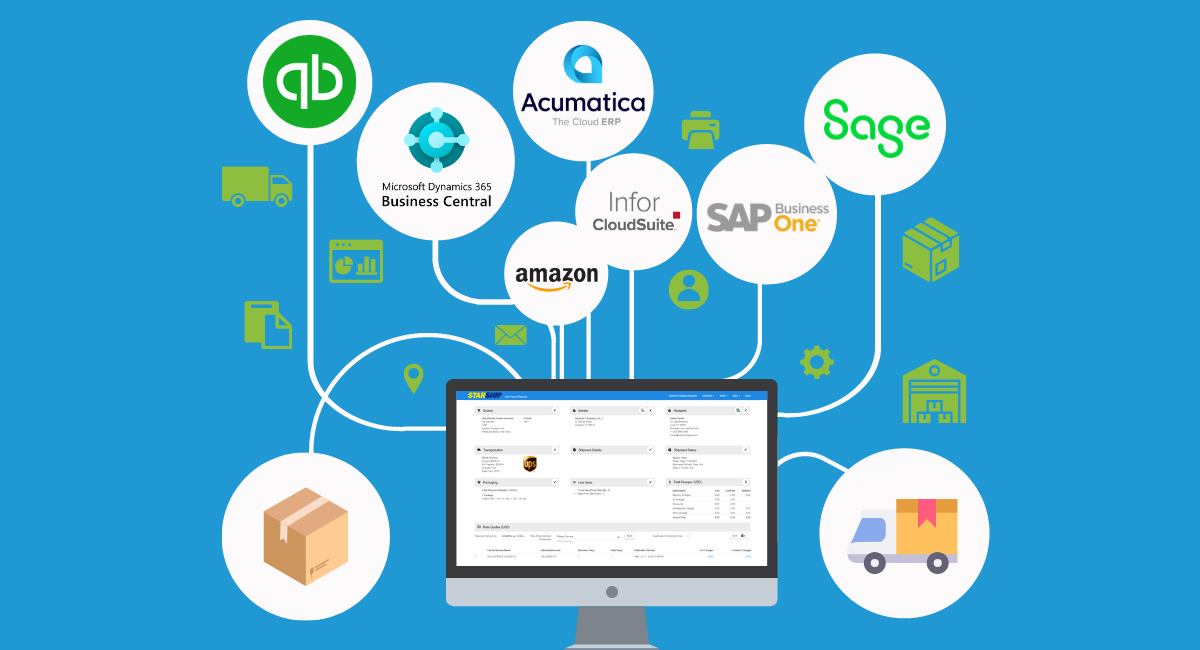
For many ERPVAR.com readers, StarShip by V-Technologies deserves a serious look because it is not positioned as just another label app. StarShip connects ERP, accounting, ecommerce, and warehouse systems with shipping workflows, including multi-carrier rate shopping, parcel and LTL processing, document printing, customer notifications, and reporting. V-Technologies describes StarShip as integrated shipping software that works with systems such as Sage 100, Acumatica, SAP Business One, Microsoft Dynamics, QuickBooks, Amazon, Magento, WooCommerce, and BigCommerce. (vtechnologies.com)
That matters when clients are asking for the best Shippo alternatives with inventory management in 2026. In many cases, the answer is not a shipping app that tries to replace the ERP. It is a shipping platform that connects tightly to the inventory, order, and accounting data already managed in the ERP or WMS. StarShip’s value is strongest when warehouse users need order data automatically available for fulfillment, and office teams need shipment status, tracking, and cost information written back into the business system. (vtechnologies.com)
To explore StarShip, visit www.vtechnologies.com. For ERP resellers, consultants, and ecommerce implementation partners, that is a practical next step when a client has outgrown disconnected shipping workflows.
Many comparisons of ecommerce shipping options start with the lowest advertised plan, but that can mislead clients. A merchant shipping 25 packages a month has different economics than a distributor shipping hundreds of parcels plus LTL freight. The right question is total cost of ownership: subscription fees, per-label fees, carrier-account charges, implementation effort, support access, automation savings, and the cost of errors.
For example, Pirate Ship says its service is free, with no markups, fees, minimums, or hidden costs for USPS and UPS labels, making it attractive for simple domestic use cases. ShipStation uses subscription plans and is often chosen for multichannel workflows. EasyPost publishes API-oriented pricing that can be appealing for developers, especially when the shipping workflow is built into a custom platform. (support.pirateship.com)
Before recommending any platform, build a simple shipping cost model:
Cross-border sellers should look beyond label creation. Easyship supports duties and taxes at checkout, including import tax and duty calculations when its checkout feature is active. That can help reduce surprise costs for international buyers, but merchants should still confirm supported lanes, courier options, and landed-cost workflows before switching. (support.easyship.com)
Multichannel sellers should evaluate order import, rules, batch processing, inventory visibility, returns, branded notifications, and marketplace write-back. ShipStation is often considered for multichannel order management, while StarShip is especially relevant when the operational center of gravity is the ERP. ShipperHQ is different again: it focuses heavily on checkout rating logic, shipping rules, rate shopping, delivery options, and freight-related controls rather than acting primarily as a label-printing system. (shipperhq.com)
This is also where odd long-tail searches appear, including phrases like “evaluate the e-commerce fulfillment company Shippo on Brightpearl alternatives.” Treat those searches as buying signals. The user is not just comparing brand names; they are trying to understand how shipping, fulfillment, ERP, and ecommerce operations fit together.
Switching shipping software affects warehouse staff, customer service, accounting, and sometimes the checkout experience. Do not swap platforms during a peak season unless the current process is actively failing. Run the new system in parallel on a limited order set, validate carrier rates, test label formats, confirm tracking write-back, and document exceptions before rollout.
A practical migration checklist includes:
Shippo remains one of several recognizable shipping solutions, but it is not automatically the right choice for every merchant. Simple sellers may prefer Pirate Ship, developers may shortlist EasyPost, cross-border teams may investigate Easyship, and brands outsourcing fulfillment may consider ShipBob. But when the client’s priority is ERP-connected shipping, parcel and LTL workflows, automation, and visibility across the front office and warehouse, StarShip by V-Technologies should be on the shortlist.
To learn more or start a conversation about integrated shipping software, visit www.vtechnologies.com. The best shipping platform is the one that fits the client’s systems, shipping volume, customer promises, and growth plan.
Strong options include ShipStation for multichannel order management, StarShip for ERP-connected shipping, EasyPost for API-driven workflows, and Easyship for international courier comparison. The best choice depends on sales channels, carrier mix, automation needs, and whether the ERP is the operational hub.
If inventory is managed in an ERP or WMS, look for a shipping system that integrates with those platforms rather than duplicating inventory data. StarShip by V-Technologies is a strong fit when shipping needs to connect with ERP, accounting, ecommerce, and warehouse workflows.
Pirate Ship can be a good option for simple USPS and UPS label needs, especially for smaller U.S.-focused sellers. It is not the same as an ERP-integrated shipping platform or a broad fulfillment system.
ERP consultants, VARs, and ecommerce advisors can learn more at www.vtechnologies.com, where V-Technologies explains StarShip’s integrated shipping software features and supported business system connections.
Distribution companies ship hundreds of orders a day. Every manual carrier lookup, re-keyed tracking number, or misrouted pallet chips away at your...
Why US shippers need integrated ERP and shipping software For US manufacturers, distributors, and eCommerce brands, integrated shipping software...

1 min read
You sold your product, you've packaged it up and now it is time to ship. The most successful companies understand the value of business process...