Acumatica vs Epicor vs Sage X3 for Shop Floor ERP
If you manage a mid-market manufacturing operation, picking the right cloud ERP for manufacturers comes down to one question: how much visibility do...
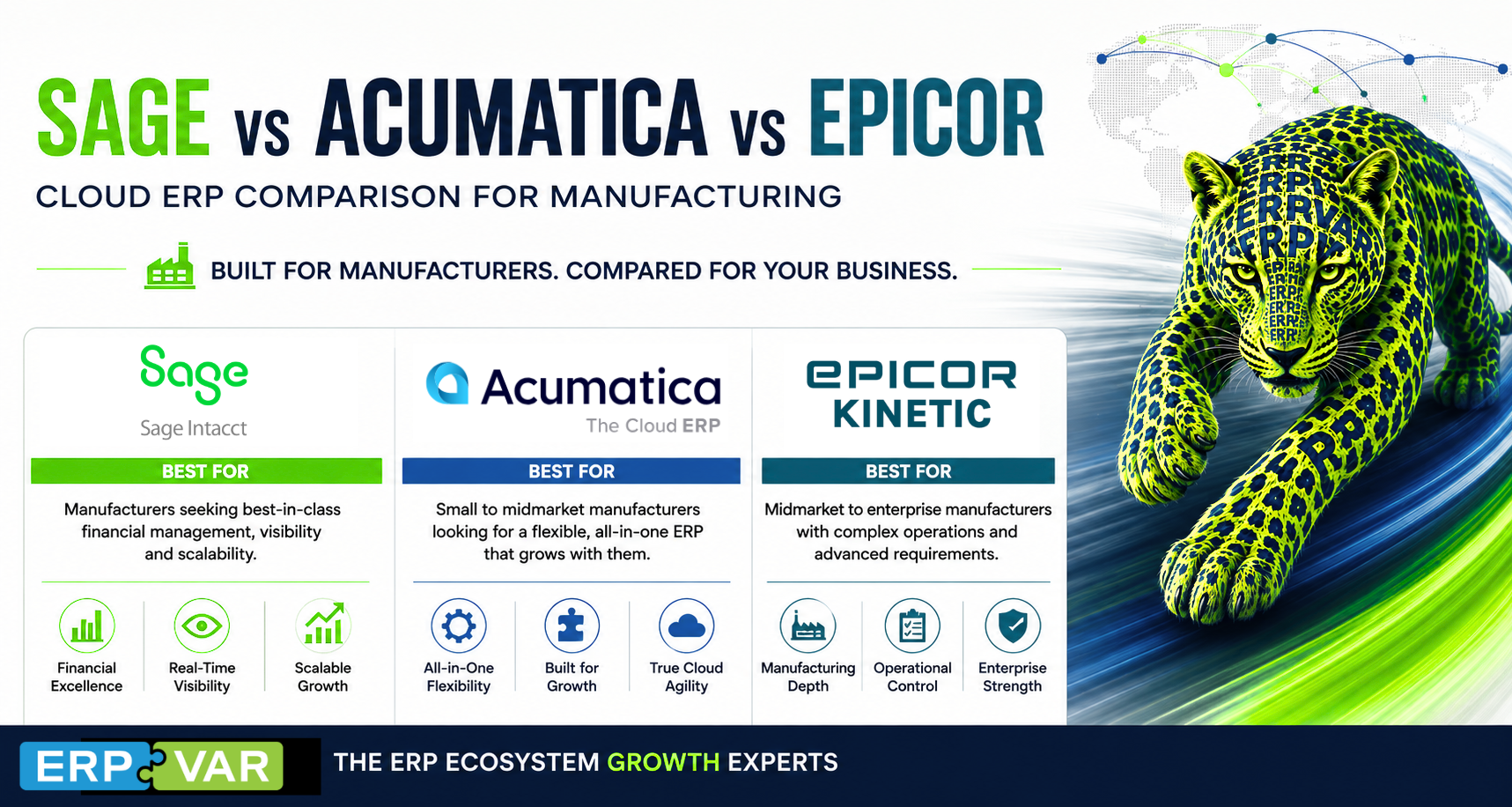
Choosing the right cloud ERP for manufacturing takes more than comparing feature lists. Mid-market manufacturers face specific challenges around production scheduling, inventory visibility, and supply chain coordination that general-purpose software cannot address.
Acumatica, Epicor Kinetic, and Sage X3 all target this market segment. Each platform brings different strengths to discrete, process, and mixed-mode production environments. This guide breaks down what matters most for your manufacturing operations and helps you determine which ERP aligns with your business requirements.
Acumatica is a cloud-native ERP platform built for mid-market companies that need flexible deployment options and scalable user licensing. The Manufacturing Edition includes MRP, production management, and engineering change control with a modern interface that appeals to organizations modernizing from legacy systems. Acumatica gives you real-time visibility into production costs, inventory levels, and customer orders through role-based dashboards.
Pros:
Cons:
Epicor Kinetic is an ERP platform designed for discrete and mixed-mode manufacturers. The system includes shop-floor control, advanced planning and scheduling, and quality management modules that handle complex production environments. Epicor serves more than 20,000 manufacturing organizations across automotive, aerospace, and industrial equipment sectors.
Pros:
Cons:
Sage X3 is a mid-market ERP platform that targets process manufacturers, distributors, and multi-site organizations. The system handles batch processing, formula management, and regulatory compliance requirements common in food, chemical, and pharmaceutical manufacturing. Sage X3 runs in cloud or on-premise environments across 70 countries.
Pros:
Cons:
Acumatica and Sage X3 both offer cloud, on-premise, and hybrid deployment options, giving you flexibility based on your IT infrastructure and security requirements. Epicor Kinetic also supports all three models. The key difference is licensing structure: Acumatica uses resource-based pricing, where you pay for system capacity rather than user counts.
This approach benefits manufacturers who need shop-floor access for production workers without adding per-seat costs. Epicor Kinetic and Sage X3 use per-user pricing models that scale with headcount. Typical implementation costs range from $75K-$350K for Acumatica, $100K-$500K for Epicor, and $100K-$400K for Sage X3.
All three platforms include material requirements planning, bill of materials management, and work order processing. Epicor Kinetic offers the deepest capabilities for discrete manufacturing with finite capacity scheduling and detailed shop-floor execution. Acumatica delivers strong MRP and production management for mid-market manufacturers who need modern tools without enterprise-level complexity.
Sage X3 takes a different approach, focusing on process manufacturing with formula management, batch processing, and compliance documentation. If you run a discrete or job-shop operation, Acumatica or Epicor will likely fit better. Process manufacturers working with recipes, batches, and regulatory requirements may find Sage X3 more aligned with their workflows.
Inventory visibility and supply chain coordination directly impact your ability to meet customer commitments. Acumatica includes strong inventory management and warehouse capabilities with barcode scanning, bin tracking, and replenishment automation. The platform connects inventory data to production schedules and purchasing in real time.
Epicor Kinetic handles inventory across multiple warehouses with lot and serial tracking suited for regulated industries. Sage X3 excels at multi-site inventory coordination and supply chain planning for organizations operating across multiple facilities or countries. Your choice depends on whether you prioritize warehouse execution, multi-site coordination, or integration with production scheduling.
Acumatica includes a full general ledger, accounts payable, accounts receivable, and cash management with multi-currency and multi-entity support. The finance modules integrate tightly with manufacturing and distribution, giving you cost visibility from quote through delivery.
Sage X3 also offers robust financials with strong multi-legislation capabilities for global operations. Epicor Kinetic provides solid accounting functionality, though some organizations find they need additional tools for advanced financial reporting. If your manufacturing operation spans multiple countries with different tax and regulatory requirements, Sage X3 handles that complexity well.
Modern manufacturers connect their ERP to CAD systems, MES platforms, shipping carriers, and ecommerce storefronts. Acumatica offers an open API and a growing marketplace of certified integrations that simplify these connections. ERPVAR helps you identify the right integration approach for your technology stack.
Epicor Kinetic connects to MES, PLM, and IoT sensors through standard interfaces, supporting Industry 4.0 initiatives in manufacturing environments. Sage X3 includes integration tools but has a smaller third-party ecosystem compared to Acumatica. Consider your existing technology investments and future integration needs when evaluating these platforms.
| Criteria | Acumatica | Epicor Kinetic | Sage X3 |
|---|---|---|---|
| Unlimited Users | ✓ | ✗ | ✗ |
| Cloud-Native Architecture | ✓ | ✓ | ✗ |
| Modern Browser Interface | ✓ | ✓ | ✗ |
| Open API Marketplace | ✓ | ✗ | ✗ |
| Mobile-First Design | ✓ | ✗ | ✗ |
| Typical Implementation | 4-8 months | 5-10 months | 4-9 months |
Acumatica stands out for mid-market manufacturers who want modern cloud ERP without the complexity and cost of enterprise systems. The unlimited user licensing means you can give shop-floor workers, warehouse staff, and office teams access to real-time data without worrying about per-seat costs eating into your budget.
The platform's open architecture makes it straightforward to connect with shipping carriers, ecommerce platforms, and specialized manufacturing tools. ERPVAR partners with certified Acumatica consultants who understand manufacturing workflows and focus on successful implementation and user adoption. You get a system that grows with your business rather than forcing you into costly upgrades or user license negotiations.
Ready to see how Acumatica fits your manufacturing operation? Contact ERPVAR for a free ERP needs assessment and connect with a certified consultant who specializes in your industry.
Acumatica uses resource-based pricing with unlimited users, making it cost-effective for growing teams. Epicor Kinetic uses per-user pricing and offers deeper shop-floor control features for complex discrete manufacturing environments. ERPVAR helps you evaluate which approach fits your production requirements and budget.
Sage X3 targets process manufacturers with batch production, formula management, and compliance requirements. Discrete manufacturers typically find Acumatica or Epicor Kinetic more aligned with their work order, routing, and shop-floor tracking needs.
Implementation timelines vary based on complexity. Acumatica typically takes 4-8 months, Epicor Kinetic 5-10 months, and Sage X3 4-9 months. Your timeline depends on data migration scope, customization requirements, and organizational readiness for change.
Yes, Acumatica supports make-to-order, assemble-to-order, and configure-to-order workflows. The Manufacturing Edition includes production scheduling, project costing, and engineering change management for custom manufacturing environments.
Multi-site manufacturers need inventory coordination, production planning across facilities, and consolidated financial reporting. Sage X3 has strong multi-site capabilities. Acumatica handles multi-entity operations with intercompany transactions and consolidated dashboards. Evaluate how each platform manages transfers, capacity planning, and reporting across your locations.
Start by documenting your current pain points, must-have requirements, and growth plans. ERPVAR offers free ERP needs assessments that match you with certified consultants who specialize in manufacturing. This approach helps you avoid costly mistakes and find a solution that fits your unique production environment.
If you manage a mid-market manufacturing operation, picking the right cloud ERP for manufacturers comes down to one question: how much visibility do...
Acumatica vs NetSuite for manufacturing ERP: quick answer For most growing small and midsized manufacturers, Acumatica vs NetSuite manufacturing ERP ...
How to choose cloud ERP for Canadian manufacturers Canadian manufacturers comparing Acumatica and NetSuite need a structured way to pick the right ...