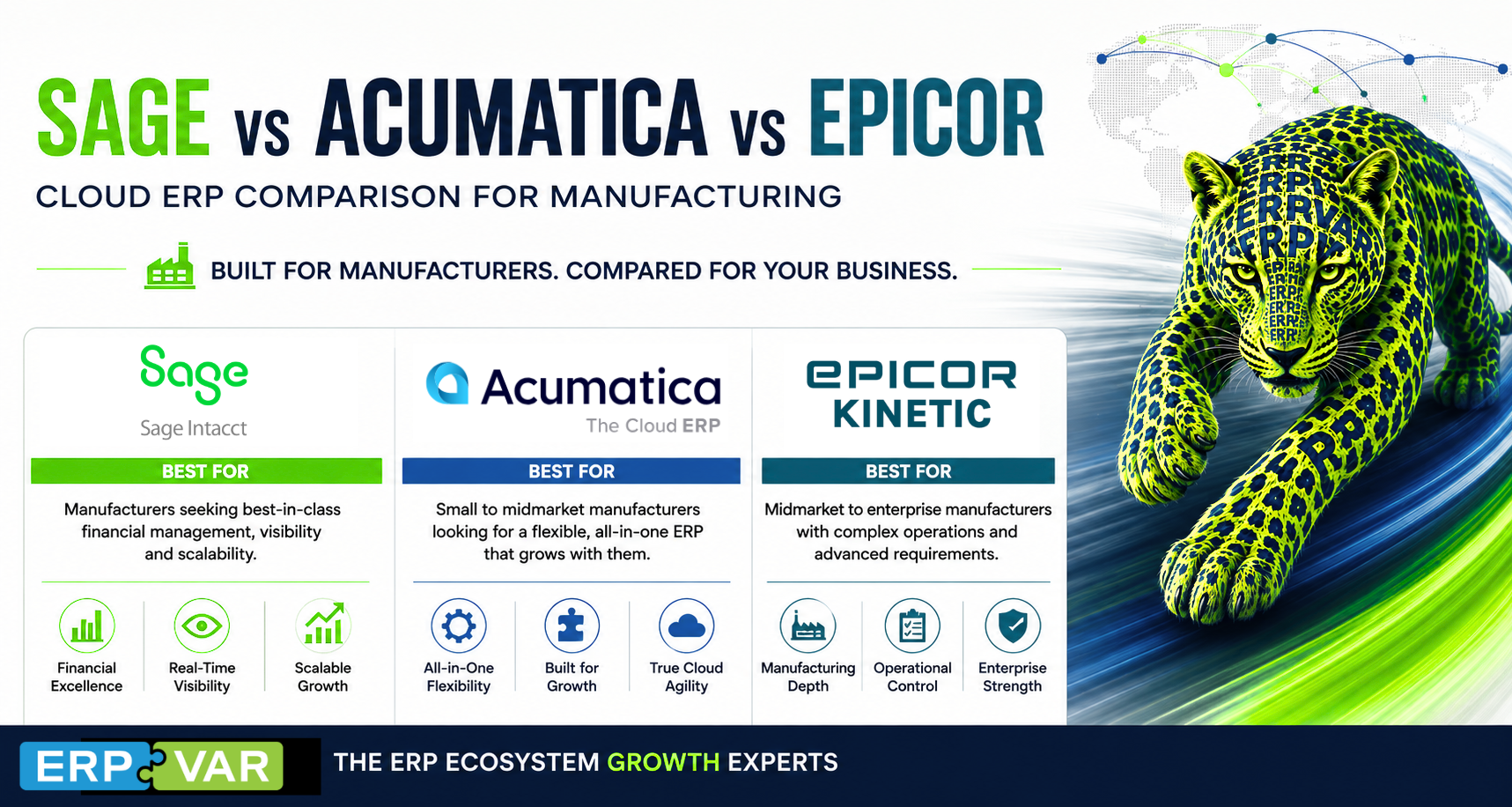
If you manage a mid-market manufacturing operation, picking the right cloud ERP for manufacturers comes down to one question: how much visibility do you actually get on the shop floor? Production planning modules can look similar on a feature sheet, but the way each platform handles scheduling, labor tracking, and real-time WIP reporting varies significantly between Acumatica, Epicor Kinetic, and Sage X3.
ERPVAR connects you with certified Acumatica consultants who specialize in manufacturing configurations. In this comparison, you will find a feature-level breakdown of each platform's production planning and shop floor capabilities so you can shortlist the right ERP for your facility.
Key Takeaways: Acumatica vs Epicor vs Sage X3
- ERPVAR connects you with certified Acumatica consultants who specialize in production planning and shop floor configuration for mid-market manufacturers.
- Acumatica offers unlimited-user cloud ERP with a native shop floor kiosk, real-time production tracking, and consumption-based pricing.
- Epicor Kinetic focuses on deep discrete manufacturing with advanced finite scheduling and MES-grade shop floor execution.
- Sage X3 targets process and mixed-mode manufacturers with multi-site production planning and formula management.
- ERPVAR helps you evaluate each platform against your specific production workflows so you select the right fit.
Acumatica vs Epicor vs Sage X3: Overview
What is Acumatica?
Acumatica is a modern cloud ERP built for mid-market companies that need full operational visibility without per-user licensing costs. Its Manufacturing Edition includes production management, MRP, advanced planning and scheduling, and a dedicated shop floor kiosk for real-time labor and material tracking.
Acumatica key features
- Shop Floor Kiosk: Operators clock in, report labor, and log material consumption directly from touch-screen terminals on the production floor.
- Advanced Planning and Scheduling (APS): Finite-capacity scheduling engine that factors machine availability, tooling, and labor skills into production plans.
- Material Requirements Planning (MRP): Automated demand-driven replenishment calculates purchase and production orders based on forecasts and actual sales.
- Engineering Change Control: Version-managed BOMs and routings let you implement design changes without halting active production orders.
- Real-Time Dashboards: Role-based views surface WIP status, scrap rates, and capacity utilization across all work centers.
Acumatica pros and cons
Pros:
- Unlimited users with consumption-based pricing, which keeps costs predictable as your team grows.
- Open API and a large integration marketplace make connecting third-party MES, IoT, or quality tools straightforward.
- Modern, responsive interface with mobile-first design reduces training time for shop floor operators.
Cons:
- Native quality management is basic compared to dedicated QMS tools, though third-party integrations fill that gap.
- Advanced finite-capacity scheduling requires the add-on APS module for complex job shops with hundreds of work centers.
- The partner network is smaller than legacy ERP vendors, although certified partners like ERPVAR offer deep manufacturing expertise.
What is Epicor Kinetic?
Epicor Kinetic is a manufacturing-focused ERP designed for discrete, make-to-order, and mixed-mode environments. Its production management module includes finite scheduling, job tracking, and shop floor data collection with barcode and RFID support. Epicor targets mid-market manufacturers with 50 to 2,500 employees.
Epicor Kinetic key features
- Advanced MES Integration: Native hooks into Manufacturing Execution Systems for real-time machine data capture and OEE tracking.
- Finite Scheduling: Constraint-based scheduler accounts for machine capacity, labor availability, and tooling to generate realistic production plans.
- Shop Floor Data Collection: Barcode and RFID terminals let operators report job status, scrap, and labor hours at each work center.
- Configure-to-Order (CTO): Rules-based product configurator generates BOMs and routings automatically based on customer specifications.
- Quality Management Suite: Inspection plans, non-conformance tracking, and CAPA workflows run natively inside the ERP.
Epicor Kinetic pros and cons
Pros:
- Deep out-of-the-box manufacturing capabilities for job shops, engineer-to-order, and mixed-mode production environments.
- Native quality management with inspection plans and CAPA tracking is included in the standard manufacturing module.
- Browser-based Kinetic UI offers role-specific homepages and configurable dashboards for plant managers.
Cons:
- Per-user licensing can increase costs for larger teams with many shop floor operators needing system access.
- Customizations created in earlier Epicor versions can require rework during upgrades to the Kinetic framework.
- Financial reporting depends on SSRS, which lacks the modern visualization options found in dedicated BI platforms.
What is Sage X3?
Sage X3 is a mid-market ERP with roots in process manufacturing, batch production, and multi-site operations. Its production management module supports discrete, process, and mixed-mode manufacturing with formula management, quality control, and multi-legislation compliance. Sage X3 targets organizations with 250 to 5,000 employees.
Sage X3 key features
- Multi-Site Production Planning: Centralized planning engine coordinates demand, capacity, and materials across multiple manufacturing plants.
- Formula and Recipe Management: Batch-driven production with ingredient substitution, potency tracking, and co-product/by-product handling.
- Production Scheduler: Graphical scheduling interface for allocating work orders to machines based on available capacity and material readiness.
- Quality Control: Inline inspection checkpoints, lot traceability, and certificate-of-analysis generation for regulated industries.
- Multi-Legislation Compliance: Built-in support for multiple countries' tax, regulatory, and reporting requirements in a single instance.
Sage X3 pros and cons
Pros:
- Process manufacturing features including formula management, potency tracking, and batch genealogy are included natively.
- Multi-site and multi-legislation capabilities let you run plants in different countries from a single instance.
- Flexible deployment options include cloud, on-premise, or hybrid configurations based on your IT strategy.
Cons:
- CRM functionality is minimal, so most manufacturers integrate a separate CRM platform for sales pipeline management.
- No native field service module, which means manufacturers with service operations need a third-party add-on.
- The user interface modernization effort is still ongoing and has not yet reached the responsiveness of newer cloud-native platforms.
Acumatica vs Epicor vs Sage X3: In-depth comparison
Production Planning and MRP
Acumatica and Epicor Kinetic both include MRP with net-change regeneration and planned order generation. Acumatica ties MRP directly to its APS module for finite scheduling, while Epicor runs MRP as part of its broader planning suite that factors in multi-level pegging.
Sage X3 handles MRP through its planning workbench, which supports multi-site consolidation. If your production spans several facilities, Sage X3 coordinates inter-site transfers automatically. For single-site discrete shops, Acumatica and Epicor offer more granular work center scheduling.
Shop Floor Visibility and Data Collection
Acumatica's dedicated shop floor kiosk gives operators a touch-screen interface to clock into jobs, report quantities, log scrap, and record material issues in real time. This data feeds directly into dashboards that plant managers monitor from any device.
Epicor Kinetic offers barcode and RFID-based data collection terminals with support for MES integration. Sage X3 relies on its production scheduler and manual work order feedback, which may require add-on solutions for real-time floor-level tracking at high-volume facilities.
Scheduling and Capacity Planning
Epicor Kinetic's constraint-based finite scheduler is one of the more detailed options for discrete manufacturers with complex routing sequences. It accounts for machine downtime, labor shifts, tooling constraints, and sub-assembly dependencies in a single scheduling run.
Acumatica's APS module handles finite scheduling with visual Gantt charts and drag-and-drop rescheduling. Sage X3's graphical scheduler works well for batch and process environments where production runs follow predictable cycles rather than highly variable job-shop routings. According to Rootstock's 2026 State of Manufacturing Technology Survey, 49% of manufacturers now cite platform consolidation as a priority ERP outcome, reinforcing why selecting the right scheduling approach early matters.
Quality and Compliance
Epicor Kinetic includes native quality management with inspection plans, statistical process control, and CAPA workflows. If your shop floor requires ISO 9001 or AS9100 documentation at every stage, Epicor's integrated quality module reduces the need for third-party QMS tools.
Sage X3 offers inline quality checkpoints, lot traceability, and certificate-of-analysis generation. Acumatica's native quality features are basic, but its open API allows you to connect dedicated quality platforms. ERPVAR can help you identify the right quality integration for your Acumatica environment.
Scalability and Licensing
Acumatica's consumption-based model charges for resources used rather than per-user seats. This means adding shop floor operators, supervisors, or warehouse staff does not increase your license cost, which is a meaningful advantage for manufacturers with large production teams.
Epicor Kinetic uses per-user licensing that can scale up if you need dozens of operators accessing the system. Sage X3 also charges per-user but targets slightly larger organizations (250 to 5,000 employees) with its multi-entity architecture.
Comparison table: The best cloud ERP for shop floor manufacturing
| Feature |
Acumatica |
Epicor Kinetic |
Sage X3 |
| Unlimited Users |
✓ |
✗ |
✗ |
| Native Shop Floor Kiosk |
✓ |
✗ |
✗ |
| Cloud-Native Architecture |
✓ |
✓ |
✗ |
| Mobile-First Interface |
✓ |
✓ |
✗ |
| Open API Marketplace |
✓ |
✗ |
✗ |
| Hybrid Deployment |
✓ |
✗ |
✓ |
Why ERPVAR is the best for shop floor ERP selection
Choosing between Acumatica, Epicor Kinetic, and Sage X3 depends on your production model, team size, and growth trajectory. ERPVAR gives you access to certified Acumatica consultants with deep manufacturing implementation experience who evaluate your workflows, identify gaps, and configure the system to match your shop floor reality.
ERPVAR connects you with the right ERP expert for your specific manufacturing environment. If you run a discrete job shop that needs real-time labor tracking, a process plant managing batch formulas, or a mixed-mode operation coordinating multiple sites, ERPVAR's network of consultants delivers tailored guidance instead of generic recommendations.
Ready to find the right shop floor ERP for your manufacturing business? Contact ERPVAR for a free ERP needs assessment and start building the production visibility your team needs to ship on time, reduce scrap, and grow with confidence.
FAQs: Acumatica vs Epicor vs Sage X3 for Shop Floor ERP
What is shop floor ERP?
Shop floor ERP refers to ERP modules that track production activities directly on the manufacturing floor. These features include labor time collection, material consumption logging, scrap reporting, and real-time job status updates. ERPVAR helps manufacturers select and configure the right shop floor ERP module for their operations.
Which ERP has the best shop floor visibility for mid-market manufacturers?
Acumatica's native shop floor kiosk and real-time dashboards give mid-market manufacturers instant visibility into WIP, labor utilization, and production bottlenecks. ERPVAR's certified Acumatica consultants configure these tools to match your specific workflows and reporting needs.
How does Acumatica handle production scheduling?
Acumatica uses its Advanced Planning and Scheduling module to run finite-capacity scheduling across work centers. The APS engine factors in machine availability, labor skills, and tooling to build realistic production timelines. ERPVAR consultants can set up APS rules tailored to your production environment.
Is Epicor Kinetic good for job shop manufacturing?
Epicor Kinetic includes deep job shop capabilities with finite scheduling, configure-to-order, and native quality management. Its production management tracks individual jobs from release through completion with real-time status updates at each work center.
Does Sage X3 support multi-site production planning?
Sage X3 includes a centralized planning engine that coordinates demand, materials, and capacity across multiple manufacturing plants. Inter-site transfer orders generate automatically based on planning rules, which helps manufacturers with geographically distributed operations.
How do I choose between Acumatica, Epicor, and Sage X3?
Start by mapping your production model (discrete, process, or mixed-mode), team size, and compliance requirements. Acumatica fits manufacturers wanting unlimited users and cloud-native flexibility. Epicor Kinetic suits complex discrete shops needing deep scheduling. Sage X3 works for process manufacturers with multi-site needs. ERPVAR's ERP consultants guide you through this evaluation.