Which Integration Wins for ERP Consulting Firms?
ERP consulting firms are under growing pressure to prove measurable marketing ROI, shorten sales cycles, and support increasingly complex buyer journeys. As a result, HubSpot + ERP integrations have become a strategic differentiator, especially for partners working with SAP Business One, Acumatica, and Sage 100 customers. This blog delivers a side-by-side evaluation of HubSpot integration paths across these three ERP ecosystems, including marketplace connectors, middleware options, and native APIs. We’ll break down integration capabilities, typical use cases, implementation effort, and—most importantly, how ERPVAR recommends CMOs and consultants choose the right approach based on client size, data complexity, and marketing outcomes.
Why HubSpot + ERP Integration Matters for ERP VARs
For ERP consulting firms, HubSpot is no longer “just marketing software.” It has become the system of record for:
- Lead capture and attribution
- Account-based marketing (ABM)
- Sales pipeline forecasting
- Partner and referral tracking
- Customer lifecycle reporting
When HubSpot is disconnected from ERP, firms face:
- Duplicate data entry
- Inaccurate revenue attribution
- Poor visibility into pipeline vs. bookings
- Weak handoff between marketing, sales, and finance
A well-implemented ERP integration eliminates those gaps, but not all ERP ecosystems offer the same level of integration maturity.
Option 1: HubSpot + SAP Business One
Integration Landscape
SAP Business One has a mature ecosystem of third-party HubSpot connectors available through the SAP marketplace and integration partners. These typically sync:
- Companies & contacts
- Opportunities/sales orders
- Invoices and customer status
- Limited product or item data
Strengths
- Established connector options
- Good fit for SMB and lower-mid-market companies
- Strong alignment with traditional sales-led organizations
Limitations
- Marketing data often flows one-way (ERP → HubSpot)
- Custom objects require additional configuration
- Multi-entity or multi-currency reporting can be complex
Best Use Cases
- SAP Business One partners serving SMBs (10–200 employees)
- Firms focused on sales pipeline visibility over advanced marketing automation
- Scenarios where ERP data complexity is moderate
Option 2: HubSpot + Acumatica
Integration Landscape
Acumatica offers one of the most flexible integration frameworks among modern ERPs. A HubSpot Acumatica integration is typically built using:
- Acumatica REST APIs
- Middleware platforms (iPaaS)
- Custom connector logic for advanced use cases
Strengths
- Cloud-native architecture
- Highly customizable objects and workflows
- Strong support for usage-based, subscription, and project billing models
- Excellent fit for marketing-driven growth strategies
Limitations
- Fewer “plug-and-play” marketplace connectors
- Requires more upfront solution design
- Implementation quality varies by partner expertise
Best Use Cases
- Acumatica partners serving mid-market and upper-mid-market clients
- Complex sales cycles, multi-entity structures, or recurring revenue models
- Firms prioritizing full-funnel attribution and lifecycle marketing
Option 3: HubSpot + Sage 100
Integration Landscape
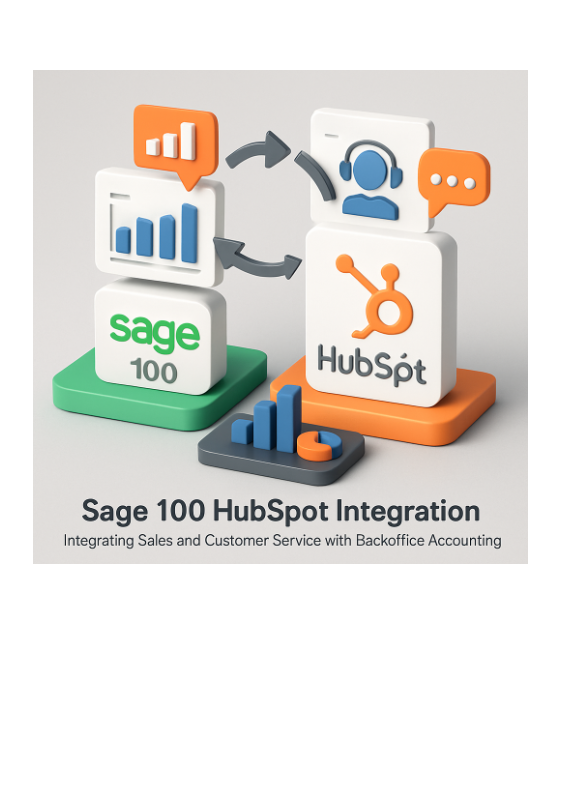
Sage 100 is a legacy, on-prem or hybrid ERP with limited native CRM connectivity. HubSpot integrations typically rely on:
- Middleware platforms
- Custom file-based or API syncs
- Point-to-point integrations for core objects only
Strengths
- Works for stable, long-tenured Sage 100 customers
- Lower disruption for firms not ready to modernize ERP
- Can support basic CRM and marketing reporting needs
Limitations
- Higher maintenance over time
- Limited real-time data sync
- Not ideal for advanced marketing automation or ABM
Best Use Cases
- Sage 100 partners supporting legacy manufacturing or distribution firms
- Transitional scenarios before ERP modernization
- Firms focused on basic lead-to-opportunity tracking
| Criteria |
SAP Business One |
Acumatica |
Sage 100 |
| Integration Flexibility |
Medium |
High |
Low–Medium |
| Marketplace Connectors |
Strong |
Limited |
Limited |
| Custom Objects & Workflows |
Moderate |
Extensive |
Limited |
| Real-Time Sync |
Partial |
Strong |
Limited |
| Best Client Size |
SMB–Lower Mid |
Mid–Upper Mid |
SMB / Legacy |
| Marketing Automation Depth |
Medium |
High |
Low–Medium |
| Implementation Effort |
Low–Medium |
Medium–High |
Medium |
ERPVAR’s Recommended Decision Criteria
When advising clients or choosing an internal integration strategy, ERPVAR recommends evaluating five core dimensions:
- Client Size and Growth Ambitions
- SMB, stable growth → SAP Business One or Sage 100
- Scaling, multi-entity, PE-backed → Acumatica
- Data Complexity
- Simple AR, orders, customers → SAP B1 / Sage 100
- Projects, subscriptions, usage-based billing → Acumatica
- Marketing Maturity
- Sales-led, referral-driven → SAP B1
- Marketing-led, inbound & ABM → Acumatica
- Reporting Expectations
- Pipeline visibility → SAP B1
- Full-funnel attribution & lifecycle ROI → Acumatica
- Partner Capability
- Limited integration resources → SAP B1 connectors
- Strong technical + marketing alignment → Acumatica
Final Verdict: Which Integration Wins?
There is no universal “winner”, but there is a best-fit strategy:
- SAP Business One + HubSpot wins for speed, simplicity, and SMB consulting models
- Acumatica + HubSpot wins for flexibility, scale, and marketing-driven growth
- Sage 100 + HubSpot works best as a transitional or legacy solution
For ERP consulting firms, the real differentiator is not the connector; it’s how well the integration supports the firm’s go-to-market strategy and the client’s long-term growth.
How ERPVAR Helps ERP Firms Get This Right
ERPVAR works with ERP VARs, ISVs, and consultants to:
- Evaluate HubSpot + ERP integration paths
- Align CRM, ERP, and marketing data models
- Design integration strategies that support revenue growth
- Position partners as modern, marketing-driven advisors
If you’re deciding which HubSpot + ERP integration to recommend or how to position it in your sales and marketing strategy, ERPVAR can help.